Barefoot at Home
You’re already spending hours at home every day. Your floors are right there. And yet, the moment you walk in, you swap out your shoes for slippers, flip-flops, or cozy socks, and your feet never actually touch the ground.
Here’s the thing: your feet are missing out on the best free training session they’ll ever get.
Barefoot at home: what your feet are really craving
Short answer? Yes, absolutely. Long answer? It’s one of the simplest, most impactful things you can do for your foot health and you don’t have to go anywhere, buy anything, or do anything special to get started.
Here’s what’s actually happening when you go barefoot at home:
- Your intrinsic foot muscles finally work: Those tiny muscles inside your foot that control arch height, toe splay, and fine-tuned balance? They’ve been on holiday inside your cushioned shoes. Bare feet on a real floor wake them up. Even walking from the kitchen to the sofa is a workout they haven’t had in a while
- Your proprioception comes back online: Proprioception is your foot’s ability to read the ground and communicate that to your brain. Through thick rubber soles, that signal is basically static. Barefoot, you get the full HD version. Your balance, coordination, and posture all benefit from a clear signal
- Your arches do their actual job: Arch support in shoes literally outsources your arch’s workload to the shoe. Go barefoot and your arch muscles have to carry their own weight, which is the whole point. It’s like the difference between a chair that does all the postural work for you versus one that makes you sit properly. Both are comfortable short-term. Only one builds strength
- Your toes remember they can spread: In regular shoes, toes get jammed together whether you notice it or not. Walk barefoot for twenty minutes and watch what your toes do when they finally have space. They fan out. They grip. They do all the things evolution spent millions of years designing them to do
And here’s the part people don’t talk about enough: the benefit accumulates. Every hour of barefoot time at home is an hour your foot muscles are doing something instead of nothing. Stack those hours over weeks and months and your feet become noticeably stronger, your balance improves, and a lot of the low-grade foot aches that felt like just part of life start to fade.
The cold floor myth: will barefoot at home give you a cold?
You know this one. The second you mention going barefoot at home, someone in your life (often someone who loves you very much) immediately says: “Put your slippers on! You’ll catch a cold!”
We need to talk about this.
Where does colds come from, actually?
Colds are caused by viruses. Rhinoviruses, coronaviruses, and their mates. They spread person to person through the air or through contact with contaminated surfaces, then touching your face. Cold floors play exactly zero role in this process.
The “cold feet = cold” belief is properly ancient and flat-out wrong. What actually happens when your bare feet touch a cold floor:
What actually happens
The one real caveat
The myth persists because it feels true: you feel cold, and later you get a cold, and your brain connects the dots. But the cold was already incubating before your feet ever touched that floor. Correlation doing its usual damage.
The cheeky irony is that regular barefoot time at home actually improves circulation in your feet over time. Your vascular system gets better at routing blood where it needs to go. Adapt long enough and your feet run warm even on stone tiles in January. We did a full deep-dive into this myth in the cold floors article: where it came from, why every culture has its own version, and what cold floors actually do for you.
Barefoot vs socks at home: what's actually better?
Socks are cozy. We get it. Nobody’s here to take your socks. But let’s be honest about what each option does:
Fully barefoot
Regular socks
Grip socks / toe socks
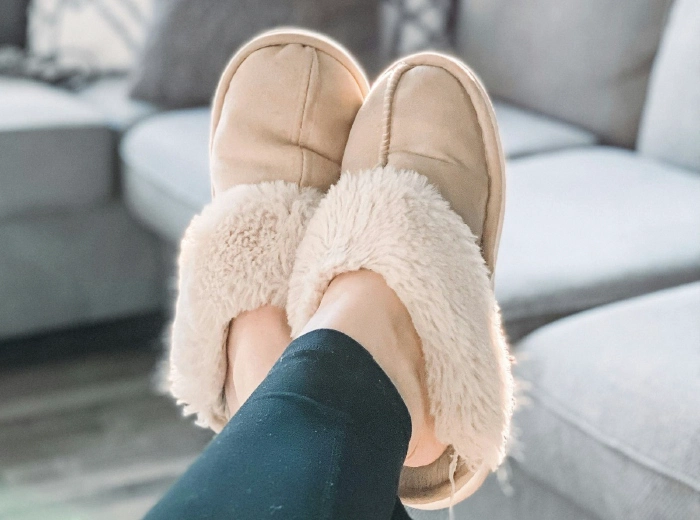
House slippers
The honest take: go barefoot when you can, use grip socks when it’s properly cold or slippery, and save the plush slippers for the rare moments your feet truly need a break. The goal isn’t to suffer on cold floors, it’s to let your feet do their job as often as possible.
Practical tips for barefoot home life
Going barefoot at home isn’t complicated, but a few things make it easier, safer, and more rewarding:
- Start with warm floors first: If you’re just beginning, start in rooms with carpet, wood, or heated tile. Cold stone in the middle of winter is a legitimate barrier when you’re not adapted. Build up gradually. Your circulation will follow
- Make it the default: The goal is for barefoot to be the automatic setting when you’re home, not the thing you do when you remember. Leave your shoes at the door and just… don’t reach for the slippers. Simple as that
- Do your foot exercises while you’re already barefoot: Toe spreads while the coffee brews. Single-leg balance while you brush your teeth. Short foot engagements while waiting for the kettle. These feel tiny but they work. Deep dive into foot strengthening when you’re ready for a proper programme
- Check your floors: Glass shards, cat toys, rogue Lego bricks. Scan your floors like a barefoot person, not someone in shoes who’d never notice. This becomes second nature within days
- Address the cold honestly: If your home actually gets cold in winter, get a few rugs or thick bath mats for the spots you stand most. Kitchen by the kettle. Bathroom tiles. You’re not cheating, you’re being smart. Some barefoot is always better than none
Different surfaces in your home
Not all floors are equal, and that’s actually brilliant:
- Hardwood or laminate: Solid, predictable. Your feet learn the feel of a smooth, slightly giving surface. Great for balance work
- Stone or ceramic tiles: Harder, cooler, more responsive to temperature changes. Great for circulation adaptation when you’re ready for it
- Carpet: Softer, warmer, lower sensory input but better for traction. Good starting point and good for recovery after harder surfaces
- Rugs on hard floor: The transition between rug edge and hard floor is actually a micro proprioception workout. Your feet notice every time
The variety is the point. Read more about walking on different surfaces to understand why your feet actually crave this kind of variation.
How home barefoot time connects to everything else
Barefoot at home isn’t a standalone habit. It’s the foundation layer of an entire way of treating your feet.
Think of it this way: if you want to go barefoot hiking, or try barefoot training, or transition to minimalist shoes, your feet need to be ready. And the cheapest, lowest-risk way to start building that readiness is exactly where you already are: your own home.
The logic flows like this:
- Barefoot at home builds base strength and daily sensory input
- Add natural terrain when you head outside, grass, soil, gravel, and your feet get a full sensory workout. The earthing article explains why direct ground contact hits different
- Then transition gradually to minimalist shoes for the time you have to wear shoes. Your stronger, more sensory-aware feet handle the transition way better. The barefoot transition guide has everything you need for this step
It all starts here. At home. In your kitchen, on your way to the bathroom, standing at your desk. Every step counts.
And if you’re still worried about cold floors, the barefoot myths article dismantles every concern you’ve ever heard with actual evidence. Worth a read before you go fetch your slippers again.
Barefoot at Home FAQs
Your home is the easiest place to start
There’s something quietly brilliant about the idea that the most accessible form of foot training in your entire life is already available to you, right now, without buying anything or going anywhere.
Your home floors are waiting. Your feet are waiting. The only thing that needs to change is deciding that the default when you walk through your door is bare feet, not slippers.
Start there. Stay there for a few weeks. Watch what happens.
The cold floor won’t give you a cold. Your arch won’t collapse. Your feet won’t fall apart. What will happen, slowly and reliably, is that they’ll get stronger, more confident, more awake. You’ll notice. Then you’ll wonder why you ever had them in shoes inside your own house.
Go deeper:
- Foot strengthening: once your feet have a base, this is the programme to give them real power
- Barefoot myths debunked: the full case against every fear you’ve been told
- Barefoot transition guide: when you’re ready to take the barefoot habit outside too
- Foot anatomy: understand exactly what’s happening in there when you walk
- Earthing: the outdoor version of what you’re already building at home
- Barefoot socks: when fully barefoot isn’t the call, toe socks are your next best move
- Barefoot and circulation: why your calf pump needs barefoot time to keep your blood moving properly