Barefoot Benefits
Your feet have 200,000 nerve endings. They’ve got 26 bones, 33 joints, and over 100 muscles built for one single purpose: to feel the ground and respond to it, brilliantly, in real time. And most of us have been switching all that off since we were toddlers.
Shoes have their place. Nobody’s saying throw them into the sea forever. But the honest truth is that going barefoot more, even just a little more, does real, measurable things for your body. No hype. No woo. Just feet doing what feet were made to do.
This is the real case for barefoot. And it’s a strong one.
Your feet are built like nothing else on Earth
Real talk: your foot is one of the most over-engineered structures in the human body. Each one has 26 bones, that’s a quarter of all the bones in your entire body, sitting below your ankles. Add 33 joints, and more than 100 muscles, tendons, and ligaments working in concert, and you’ve got a live feedback system that most modern footwear simply turns off.
That system was designed to do something specific. Every step you take, your foot is supposed to feel the ground, read its texture, its slope, its give, and send that data up through your ankles, knees, hips, and spine so your whole body can adapt. It’s not just a platform you stand on. It’s a sensor array.
What happens when you wear conventional shoes?
The problem isn’t shoes in general. The problem is that thick, cushioned, raised-heel shoes stop the sensor array from doing its job. When your foot is wrapped in padding and can’t splay, flex, or feel, those 200,000 nerve endings go quiet. The muscles in your arch, your toes, your heel, they stop being asked to do much. So they don’t.
Over time, the muscles weaken. The arch loses its spring. The toes get compressed into a narrow box. Your balance degrades slightly because you’re getting less ground feedback. And because your heel is elevated (even a small raise changes your whole-body mechanics), your posture starts compensating in ways you don’t even notice.
This isn’t a horror story. It’s just physics. Use it or lose it, and most of us haven’t been using it. Check out the full breakdown in the foot anatomy guide if you want to see exactly what all 26 bones are supposed to be doing.
Going barefoot doesn’t fix everything. But it wakes your feet back up. And that matters more than most people realize.
What barefoot actually does for you
Studies suggest going barefoot more, on safe natural surfaces, delivers a surprisingly wide range of benefits. Here’s what the research and real-world experience both point to:
- Stronger feet, for real: When your feet carry you without a thick sole doing the work, the intrinsic muscles of your foot actually have to engage. Over time, they get genuinely stronger. People who go barefoot regularly tend to have wider, more muscular feet and stronger arches, not flatter ones
- Better balance and proprioception: Proprioception is your body’s sense of where it is in space, and your feet are one of its main inputs. Barefoot contact with the ground gives your nervous system way more accurate data than padded shoes do. Studies consistently show improved balance scores in people who spend regular time barefoot
- Lower impact forces through your joints: This sounds counterintuitive when you’re used to the “cushioning = protection” logic, but barefoot walking naturally shifts you to a midfoot or forefoot strike instead of a hard heel slam. That actually reduces the shock wave traveling up your leg
- Healthier toe alignment: Shoes with narrow toe boxes push your toes together year after year. Barefoot time lets your toes spread naturally, which helps with toe mobility, grip, and the prevention of issues like bunions and hammertoes
- Improved sensory feedback for your whole nervous system: More nerve activation in your feet means your brain gets better information about your movement, leading to more efficient, more coordinated motion
- Plantar fasciitis recovery support: This one surprises people. The conventional advice is to cushion and rest, but studies suggest that careful barefoot strengthening can actually help rebuild the foot’s support structures, reducing the load on the fascia over time. Slow and smart is the key here
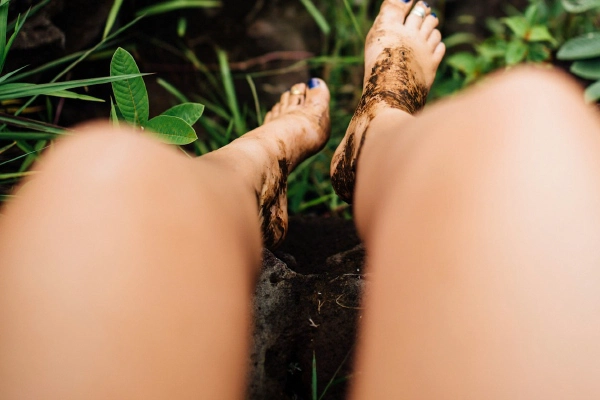
- Earthing benefits on natural surfaces: When you’re barefoot on grass, soil, or sand, you’re also getting direct electron transfer from the Earth’s surface. There’s growing research pointing to anti-inflammatory effects. Worth reading the full earthing guide if you haven’t already
Honestly, the list is longer than most people expect. Because feet aren’t just feet, they’re the foundation of the whole system. When they work better, a lot of other things do too.
The posture cascade: feet, knees, hips, spine
Here’s the thing most people miss: your feet don’t exist in isolation. They’re the bottom of a chain that runs all the way to the top of your head, and when the bottom of the chain is off, everything above compensates.
When your feet are weak or your heel is elevated by a raised shoe, your ankles tilt forward slightly. Your knees follow. Your hips rotate to adjust. Your lower back arches to compensate for that rotation. Your shoulders shift. Your neck adjusts. By the time you trace the whole thing back to its source, what started as “I wear slightly heeled shoes” has become a full-body postural pattern that runs 24/7.
What barefoot walking does to the chain
Going barefoot brings your heel back to the same level as your forefoot. That sounds small. It isn’t. With your foot flat and your toes able to spread, your ankle stacks naturally over your heel, your knee tracks more cleanly over your second toe, and your hips find a more neutral rotation. The lower back often releases tension it’s been holding for years.
People switching to more barefoot time and flat footwear frequently report that old knee niggles ease up. That lower back tightness that seems to have no cause? Sometimes it was the shoes all along. Not always, but often enough that it’s worth knowing about.
We go deep on all of this in the posture and feet connection article, because the chain reaction up the spine is fascinating and the implications are genuinely life-changing for some people.
Your feet are not just transportation. They’re the foundation your whole posture is built on.
The honest bit
Barefoot is genuinely great for most people. But “most” isn’t “everyone,” and this blog isn’t going to pretend otherwise.
If you have diabetes with peripheral neuropathy, going barefoot needs to be approached carefully. Reduced sensation means you might not feel a cut or abrasion, and wounds on diabetic feet heal differently. It’s not a flat “no,” but it’s a “talk to your doctor first and be very deliberate about it.”
People with active foot injuries, recent surgery, or certain structural conditions should also check in with a professional before going all-in on barefoot. Not because barefoot is dangerous, but because context matters and a good physio or podiatrist can help you use it as a tool rather than accidentally making something worse.
Plantar fasciitis is nuanced. As mentioned above, careful barefoot strengthening can help over time. But if you’re in the acute phase with serious inflammation, jumping straight into long barefoot walks on hard floors is probably not the move. Build into it.
The full picture on health conditions and barefoot is covered in the barefoot and health conditions article. The short version: for the vast majority of people, more barefoot time is simply good. For a small group, it requires a bit more thought. Know which camp you’re in.
Barefoot Benefits FAQ
Your feet are ready when you are
No cap: your feet are probably the most underused part of your body. Decades of cushioning, support, and elevation have dialled down their function, not because feet are fragile, but because we stopped asking them to do anything. The good news is that the body adapts. Give your feet back some ground contact, some challenge, some space to move, and they respond.
You don’t need to overhaul your life. Start small. Shoes off at home. Barefoot on the grass when the moment’s there. A walk without shoes on a safe surface. These tiny inputs add up. The feet are waiting, honestly, they’ve been waiting a while.
Go deeper into the barefoot world:
- Earthing: the science behind bare skin on the Earth’s surface and what it’s actually doing
- Barefoot on natural ground: grass, earth, sand, forest floor, the natural terrain playbook for stronger and more connected feet
- Best walking surfaces: where to walk barefoot and what each surface gives you
- Foot strengthening exercises: how to build the strength your feet need to thrive without shoes
- Barefoot transition guide: the smart way to shift your lifestyle without wrecking yourself
- What podiatrists say about barefoot: the debate inside the profession and what the evidence-based practitioners actually think