China's Barefoot Doctors
Picture this: a country of 700 million people. Most of them farmers. Almost none of them with access to a trained doctor. Now imagine solving that problem not by building hospitals, not by waiting for enough doctors to graduate, but by training the farmers themselves.
That’s what China did in the 1960s. And it worked in ways that still blow minds today.
Who were the barefoot doctors?
When Mao Zedong launched the Cultural Revolution in the mid-1960s, China had a problem that no policy paper could easily fix. The country had roughly 40,000 Western-trained doctors, almost all of them concentrated in cities, serving a population that was 80% rural. If you lived in a village, you had basically nothing. Maybe a folk healer. Maybe not even that.
In 1965, Mao gave a speech where he declared that healthcare had been stolen from the countryside by city-dwelling intellectuals, and that it needed to be given back to the people who worked the land. The solution that emerged was radical: take peasants, young ones especially, and give them three to six months of intensive medical training. Then send them home. Let them work in the fields like everyone else. And have them handle the healthcare their community needed.
They were called 赤脚医生 (chījiǎo yīsheng), the barefoot doctors. At their peak in the early 1970s, there were about 1.8 million of them across China.
What did they actually do? Quite a lot:
- Preventive care and basic hygiene education for entire villages
- Vaccination campaigns that reached communities no hospital truck ever visited
- Treating common infections, wounds, minor injuries, and illnesses
- Maternal and child health care, including deliveries in remote areas
- Knowing when a case was beyond them and getting the person to a real hospital
- Acupuncture and traditional remedies alongside basic Western medicine
Not perfect care. Not a replacement for trained physicians. But something that had never existed at this scale before: actual medical attention for hundreds of millions of people who previously had nothing.

The meaning was in the feet
Here’s where it gets interesting for us. The “barefoot” part wasn’t just a quirky nickname. It was deeply intentional.
In Chinese culture, “barefoot” specifically meant the rice paddy farmers, the ones who rolled up their trousers and worked ankle-deep in flooded fields. The people at the very bottom of the social ladder. When these health workers were called barefoot doctors, it meant they were of the earth. They weren’t coming down from universities or city hospitals to fix the peasants. They were peasants themselves. They knew the same ground. They ate the same food. They understood the same worries.
The barefoot part was the whole point. It meant: your healer is someone who stands on the same earth you stand on. No white coat, no glass waiting room, no distance.
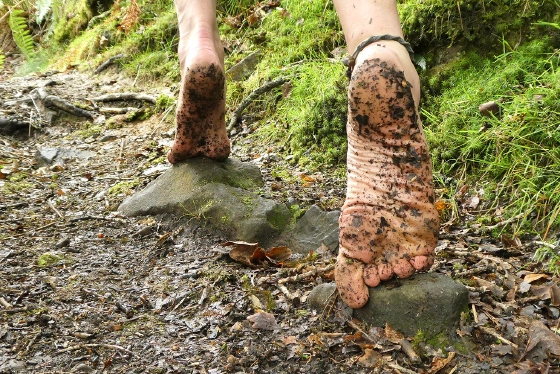
In the countryside, they genuinely did work barefoot alongside the farmers, in rice paddies and on dirt paths, before putting on a simple apron and seeing patients in the village meeting room. The earth they worked in was the same earth their patients lived on.
There’s something in that which barefoot culture has always understood: when you’re on the same ground as the person next to you, something shifts in the relationship. The Brownies knew it. The barefoot doctors knew it too, whether they’d have described it that way or not.
Why the World Health Organization actually praised this
Here’s something that surprises people: in 1978, the World Health Organization held its landmark Alma-Ata Declaration conference, where global health leaders gathered to define what “Health for All” should mean. The Chinese barefoot doctor model was held up as a genuine example of how to deliver primary healthcare in low-resource settings.
The principle that came out of that conference, that healthcare should be brought to where people actually are, using community-based workers who understand the local context, was directly inspired by what China had been doing for a decade.
Other countries started trying versions of it. Community health workers in Africa, village health volunteers in Southeast Asia, health promotoras in Latin America. The DNA of all those programs has some barefoot doctor in it.
The WHO didn’t praise it because it was ideologically tidy. They praised it because it solved a real problem that no other approach had cracked: how do you get basic healthcare to people who live far from any hospital, in communities where trained doctors will never live, when you have limited resources and enormous scale?
The answer turned out to be: you train someone from inside that community. Someone who walks the same earth.
The end of the barefoot era
When China’s economic reforms kicked in through the 1980s, the commune system that had funded barefoot doctors collapsed. Collective agriculture was replaced by household farming. The cooperative healthcare financing that paid for these community workers dried up.
Many barefoot doctors, given the choice, pursued formal medical education. A number of them became the fully trained doctors and nurses who built China’s modern healthcare infrastructure. Their brief but intense training had given them a foundation to build on.
By 1985, the official barefoot doctor program was essentially over. In its place came a system more like the rest of the world’s, formal credentials, privatized clinics, fees for service. Better trained, in many ways. But harder to reach for people without money or who lived far from a facility.
Health economists still debate the tradeoffs. What wasn’t debatable was the scale of what had happened: for roughly 20 years, the most basic kind of healthcare had reached communities that had never had it before, delivered by people who stood in the same earth.
That’s a fact that stands on its own, whatever you think of the politics around it.
Why this story still matters
The barefoot doctor model keeps coming up in global health conversations for a reason. The problem it solved, getting basic healthcare to people in resource-limited settings, hasn’t gone away. About half the world’s population still lacks access to essential health services, according to WHO estimates.
What the barefoot doctor experiment demonstrated was something that runs counter to how healthcare is usually designed: expertise doesn’t have to come from outside. The most effective healer for a community might already be inside it, if you’re willing to train them and trust them.
That principle shows up in modern community health worker programs, in midwife-led care in rural contexts, in mental health peer support programs. It’s the same instinct dressed differently: bring care to where people are, using people who already belong there.
And the barefoot part? The being of the earth, not above it? That spirit connects to something much older than Mao’s China. It connects to the simple fact that throughout human history, the healers who communities trusted were the ones who shared their ground. Who walked the same paths. Who knew what the soil underfoot actually felt like.
For the meaning of going barefoot, this story is a surprisingly good teacher.
Barefoot Doctors FAQ
What a barefoot health worker taught the whole world
The barefoot doctors were not perfect. The program existed inside a political moment with deep contradictions. The forced retraining of educated doctors and urban professionals during the Cultural Revolution caused genuine harm. Those things are true.
But what the barefoot doctors achieved, what the concept proved, is also true and worth keeping. That healthcare doesn’t have to come from above. That a person trained inside their own community, who walks the same earth, often reaches people that no official system ever would. That the barefoot choice, the choice to be on the same ground as the person you’re helping, carries real meaning.
That lesson didn’t die with the program. It’s still being applied, in different forms, in communities across the world. And every time someone asks why a health worker from inside the community works better than one parachuted in from outside, the answer starts somewhere in those Chinese rice paddies in 1966.
Stand on the same earth. That’s where trust begins.
Go deeper into the barefoot world:
- Barefoot cultures around the world: the global tradition of going unshod
- The meaning of barefoot: what bare feet symbolize across history and culture
- Earthing: the science of bare skin on the ground: what actually happens when you connect with the earth
- Barefoot legends: the historical figures who changed everything without shoes