Barefoot Dreams
You wake up and the dream is still there. You were walking somewhere, barefoot, and it felt weirdly significant. Maybe the ground was warm and perfect. Maybe you were anxious because you couldn’t find your shoes. Either way, something about those bare feet in the dream stuck.
Turns out your brain is doing something deliberate. And it’s worth paying attention.
Why do so many people dream about bare feet?
Barefoot dreams are genuinely one of the most reported dream experiences across cultures. Not “I flew over my hometown” common, but up there. And it makes sense once you think about what bare feet represent to the sleeping brain.
Your feet are your point of contact with the world. Every day, even if you don’t think about it, your feet are navigating reality. They carry you forward. They keep you stable. They feel the ground beneath you. So when the brain goes into dream mode and starts working through the day, through your worries, your hopes, your half-processed emotions, it often reaches for feet as the symbol.
Going barefoot in a dream strips that symbolism down to its most raw form. No shoes, no protection, no performance. Just you and the ground, unmediated.
What psychologists say
What cultures say
What your body says
What different barefoot dreams actually mean
Context is everything in dream interpretation. The same bare feet can mean wildly different things depending on how the dream felt and what was happening. Here are the most common barefoot dream scenarios and what they’re usually pointing at:
Walking barefoot on grass or soft ground (and it feels good)
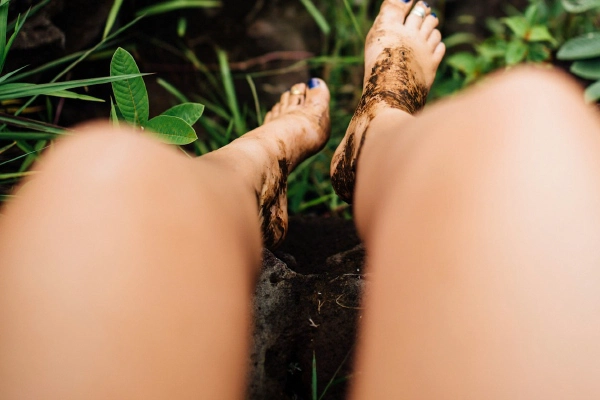
This is the dream equivalent of a long exhale. If you’re walking barefoot on grass, sand, or soft earth and it feels warm, calm, and natural, this usually signals a deep desire for simplicity or a need to reconnect with something uncomplicated. You might be carrying too much right now. Your sleeping brain is showing you what it looks like to put some of it down.
This kind of dream often shows up after a period of high stress, when the body and mind are craving sensory simplicity. Exactly the kind of thing barefoot walking on natural surfaces can actually deliver when you’re awake.
You’ve lost your shoes and can’t find them
Classic anxiety dream, but not necessarily a bad sign. The shoe-loss dream usually points to feeling unprepared, unexpectedly exposed, or like you’re being asked to perform without your usual tools. New role at work. First date. An important presentation you’re not sure you nailed.
The barefoot-in-public version of this dream (where you suddenly notice you have no shoes in a place where you should) is almost always about social vulnerability. Not fear of the ground. Fear of being seen as less than you want to appear.
Walking barefoot in a sacred or important place
This one is different in texture. If you’re barefoot in a temple, a church, a forest that feels ceremonially significant, or any place that carries weight in the dream, this is often interpreted across many traditions as readiness. You’re prepared for something real. Something that requires your full attention and no armor.
The biblical tradition of “holy ground” runs deep here. Removing your shoes before entering somewhere sacred is an act of complete presence. Your sleeping brain may be telling you you’re ready to show up like that.
Running barefoot and it feels free
Pure liberation dream. Running fast, barefoot, not afraid of the ground, this is your mind playing out a fantasy of freedom, capability, and naturalness. Often shows up when waking life feels overly managed, constrained, or when you’ve been spending too much time performing versus just being. The barefoot running article covers what this feels like awake, but in a dream it’s usually all metaphor.
The ground feels wrong: glass, rough surfaces, danger
Not every barefoot dream is a good one. If you’re walking barefoot and the ground is threatening, glass shards, hot asphalt, sharp rocks, and you feel anxious, this is often about vulnerability in a hostile environment. Something in your waking life is feeling like risky terrain with no protection. Worth sitting with. What area of your life feels like you’re walking on glass right now?
Barefoot dreams across cultures
Dream interpretation is one of the oldest human practices, and bare feet show up in traditions everywhere. Here’s what different cultures have made of it:
- Ancient Egypt: Dream texts from papyri show that walking barefoot often signified approaching a significant transition. The removal of footwear was connected to crossing thresholds, literal and metaphorical
- Indigenous traditions across the Americas: Many traditions link barefoot dreams to ancestral communication. Your ancestors walked this land before you. To dream yourself barefoot is sometimes read as a moment of closeness with those who came before
- Chinese dream tradition: Barefoot dreams were often associated with poverty or loss in older interpretations, but also with unexpected freedom. Context mattered enormously. The barefoot scholar dreaming of walking freely was a trope in classical literature
- Islamic dream interpretation: Bare feet in dreams are sometimes read as a sign of approaching a pure or humble state. The ritual removal of shoes before prayer gives shoes a strong role in the symbolic vocabulary
- European folk tradition: Brownies, those barefoot woodland spirits who know every inch of the forest floor, are always dreaming-adjacent in the folk imagination. They’re the ones who visit you in the spaces between sleep and waking, feet touching the earth even in the dream world. The Magikitos carry this exact energy: barefoot even in sleep, always connected
What’s striking is that almost no tradition interprets barefoot dreams as trivial. They’re consistently treated as significant. Something about feet-to-earth in the dream state registers as a communication worth paying attention to.
How your barefoot waking life affects your dreams
Here’s something interesting: people who regularly walk barefoot, whether at home, on grass, or on natural terrain, often report that their barefoot dreams have a different quality to them. More sensory. More specific. More grounded (literally).
It makes sense. Your brain builds its dream imagery from experience. If your experience of being barefoot is rich, tactile, and pleasurable, those memories become dream material. The warm grass under your feet on a Tuesday morning becomes the floor of a dream you have on Friday night.
This creates a kind of loop. The more intentional barefoot time you have in waking life, the richer the sensory vocabulary your brain has for dreams. Some people who practice barefoot earthing regularly describe a shift in their whole dreamscape, not just barefoot dreams, toward something more grounded and vivid.
The barefoot at home guide is honestly the simplest way to start feeding that loop. Feet on real floor. Twenty minutes. Every day. Watch what happens to the texture of your sleep over a few weeks.
The spiritual dimension of barefoot dreams
Some people don’t frame dreams in psychological terms at all. For them, dreams are a channel: to intuition, to spiritual guidance, to dimensions of experience that waking consciousness can’t easily access.
In that context, barefoot dreams carry their own weight.
Across contemplative traditions, the connection between bare skin and sacred ground is taken very seriously. To walk barefoot is to be vulnerable and open in the most literal sense. Nothing between you and the earth. In dreams, that image often signals that you’re in a space of genuine receptivity.
Barefoot in a dream, from this perspective, might mean:
You're open to something new
You're being called to simplify
You're close to something true
Your roots are speaking
Barefoot Dreams FAQs
Your feet know something your waking mind is still figuring out
Dreams are strange, unreliable, and genuinely fascinating. The same image can mean completely different things in different contexts. But barefoot keeps showing up across cultures, across centuries, across traditions, as a sign of something real: presence, vulnerability, readiness, connection.
If you’re having barefoot dreams, your sleeping brain is doing something deliberate. Maybe it’s processing stress about exposure. Maybe it’s pointing toward a desire for simplicity you haven’t made room for. Maybe it’s just your body remembering that it was built to feel the earth.
Worth listening to.
And if the dream leaves you with a pull toward actually walking barefoot more in your waking life? Follow it. The barefoot at home guide is the easiest starting point. The earthing article covers what happens when that ground contact gets real. And barefoot mindfulness is the conscious, eyes-open version of exactly what your sleeping brain is exploring. The barefoot folklore article puts those folk dream interpretations in their full cultural context, and it turns out your ancestors were onto something real.
Your feet have been speaking this language since before you were born. The dreams are just the overnight messages.