Barefoot Folklore
Your grandmother had opinions about bare feet. So did her grandmother. And her grandmother’s grandmother. Every culture in Europe built up a whole vocabulary of folk beliefs around going without shoes: what it meant, when it was fine, when it was risky, what kind of energy it carried.
Some of that folk wisdom was nonsense. Some of it was carrying real knowledge in story-shaped clothing. Here’s how to tell which was which.
What folk tradition actually preserves
Folk belief isn’t random. It doesn’t preserve nonsense well because nonsense doesn’t get repeated down generations. What survives in folk tradition is the pattern that enough people noticed enough times that it stuck. The story wrapping it might be mythology. The explanation might be completely wrong. But the observation underneath often isn’t.
European folk traditions around barefoot have three recurring threads that show up across cultures that never talked to each other:
The Earth Connection
Dreams and Feet
The Creatures Knew
Brownies, dew walks, and the luck of the first bare foot
In British and Celtic folk tradition, the relationship between bare feet and earth was charged with meaning. Country folk who went barefoot to plant crops weren’t just doing it because shoes were expensive. They were following traditions that said something about the quality of attention the work deserved.
The Brownies, those legendarily barefoot small folk of British and Scottish forests, were always described as excellent judges of character. Their test was simple: watch how someone walked on the earth. A person with awareness of what they were stepping on was worth trusting. Someone who stomped and plodded, shoes or no shoes, had missed the whole point.
Luck and bare feet were intertwined in English country tradition. Running through rural English and Scottish folklore is the persistent idea that the first bare foot on new land in spring was connected to the year’s fortune. Not formal magic, just a recognition that the person willing to feel the earth directly was somehow more in relationship with it.
Then came the warnings. Going barefoot on churchyard ground was said to invite unwanted attention. Going barefoot before thunderstorms meant you’d feel the charge through your feet before others noticed the sky changing. Barefoot through morning dew on Midsummer’s Day was a cure for eye complaints and skin troubles. Folk medicine and folk belief were inseparable because they emerged from the same place: repeated observation that something happened when feet met certain kinds of earth.
The Magikitos understand this exactly. Every one of those forest spirits is barefoot because folk imagination understood it long before research: the ground doesn’t give up its knowledge through shoe leather. Direct contact is the whole deal.

The old warnings and what was actually going on underneath them
Folk belief developed a whole protective layer around bare feet, especially for children. Don’t go barefoot on cold floors or you’ll catch cold. Don’t go barefoot after dark. Don’t go barefoot in rain or your chest will suffer.
These beliefs seem like nonsense now, and most of them are, medically speaking. Cold floors don’t cause respiratory infections. Night air doesn’t make illness. What the warnings were actually tracking was something real but mis-explained: bare feet meant exposure, vulnerability, the territory of the young and the unsupervised. The superstitions were managing attention without having to explain proprioception or immune thresholds.
Some folk warnings were oddly specific and turn out to have a genuine basis. Barefoot in standing water was consistently warned against across European traditions. Standing water in pre-modern contexts was indeed where waterborne infection concentrated. The tradition wasn’t about magic. It was tracking something real without the vocabulary for epidemiology.
Other beliefs were about attention and presence. The instruction not to walk barefoot in anger, which shows up in various forms across British and Irish country tradition, was not superstition. It was observation: someone who is agitated and barefoot outdoors is not paying attention to the ground. That’s when you cut your foot on something you should have noticed. The belief encoded the real risk in the only story format available.
The folk observations that turned out to be real
Folk medicine across Europe used barefoot-on-dew as a specific remedy for centuries. Sebastian Kneipp, the 19th-century Bavarian priest who became one of the most influential figures in European natural medicine, built his whole approach partly on walking barefoot on cold morning grass. He didn’t invent the idea. He formalised what folk tradition had already established for centuries before him.
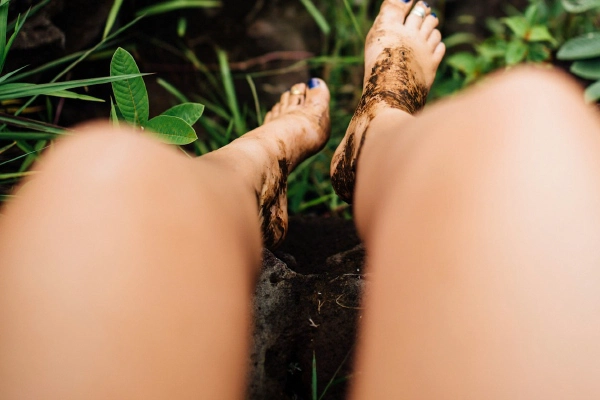
What was the tradition actually tracking? Probably several things at once. The cold stimulus improves circulation in the feet and legs. The sensory stimulation wakes up the nervous system. The damp grass means ground contact and light earthing effects. The act of walking slowly on uneven terrain is proprioceptive training. Doing it outdoors in morning air adds its own layer.
Folk tradition compressed all of that into “walk barefoot on morning dew and you’ll be healthier.” Wrong explanation. Right observation.
- Morning dew barefoot walking: Folk medicine across Europe. Kneipp formalised it in the 19th century. Research now understands that cold foot stimulus improves circulation and activates the autonomic nervous system
- Barefoot on grass for restlessness: Old English and German folk remedy for anxiety. Direct ground contact reduces cortisol levels, which is what earthing research now describes in more technical language
- Barefoot in river stones: Folk physiotherapy from multiple traditions. Walking on varied natural surfaces stimulates plantar nerve endings and intrinsic foot muscles in ways flat floors physically cannot. What we now call sensory trail therapy
- “Let the feet breathe” in summer: Folk wisdom across all five European language areas. Exactly right: shoe-trapped feet develop fungal conditions, restricted toe movement, and reduced muscle function that regular barefoot time genuinely reverses
- Barefoot children run better: Near-universal folk observation. Modern biomechanics confirms that children who spend time barefoot develop stronger intrinsic foot muscles and better balance than those who are always shod
Foot reflexology: the folk tradition that's still running
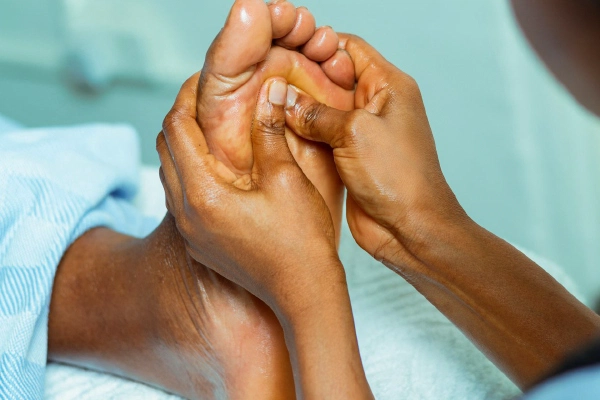
Traditional Eastern and European folk medicine both developed the idea, independently, that the sole of the foot was in some way a map of the body. Press the right zone, affect the right organ. The mechanism they described was mythological. But the observation that pressure on different foot zones produces different sensations and some therapeutic responses… that part has enough modern support to keep the practice going across multiple centuries of scrutiny.
Foot reflexology sits right at that edge between folk tradition and documented effect. It’s one of the cleaner examples of folk observation outlasting its original explanation. The “why” the tradition gave was wrong. The “what” it was pointing at was real enough to survive.
The same pattern shows up in the folk tradition of foot massage for feverish children, for exhausted travellers, for people recovering from illness. Not because feet are magical, but because they have around 200,000 nerve endings and are genuinely one of the most sensorially responsive parts of the body. Stimulate them well and the whole system responds. Folk healers noticed that. They built practices around it. The practices outlived the folk cosmologies that explained them.
What folk imagination kept trying to say
The barefoot forest spirit keeps coming up in any discussion of European folk tradition and bare feet, because folk imagination kept arriving at it. In culture after culture, in tradition after tradition with no connection to each other, the being of special wisdom and deep forest knowledge was always barefoot.
You can read that as coincidence. Or you can read it as folk tradition encoding an observation across languages and centuries: the being most truly in relationship with the earth doesn’t wear a barrier against it. The most knowing one is the most directly connected.
The Brownies of British folklore didn’t choose barefoot. They existed barefoot. Shoes, for them, would have been like putting gloves on for a conversation with the earth. Every root, every stone, every cold morning damp of soil was something they were reading. Their knowledge wasn’t separate from their barefoot contact. It came through it.
That’s the observation folk tradition kept reaching for, in creature after creature, across languages that never shared a word. The ground knows something. Bare feet is how you have the conversation. The barefoot cultures article goes into how this shows up in formal religious traditions too. The earthing article covers the science underneath it.
The folk tradition and the research are pointing at the same place. They’re just arriving from different directions.
Barefoot Folklore FAQs
What the old stories were carrying
Folk tradition gets dismissed a lot. Old wives’ tales. Superstition. Unsophisticated explanations from people who didn’t know better.
But folk tradition has a filtering mechanism that science doesn’t: time. Only the observations that kept being confirmed, generation after generation, get preserved. Everything else gets quietly dropped. When you find something that survived centuries of repetition across different cultures, you’re looking at something that passed enough practical tests to keep being passed on.
The barefoot wisdom of European folk tradition passed that test. Morning dew walks. Earth contact. Natural varied surfaces. Barefoot children who run better. The creatures that know the forest by feel. These observations were repeated because they reflected experience. Not because they had the right vocabulary for what they were tracking.
You’re now living in a time when we have most of that vocabulary. Earthing. Proprioception. Intrinsic foot muscle function. Sensory stimulation. The science caught up to what the folk tradition was trying to describe.
Your grandmother was right about the morning dew. She had the mechanism completely wrong. But the observation? That one was always solid.
Go deeper into what the folk traditions were pointing at:
- Barefoot dreams: where folk interpretation of barefoot in sleep meets modern understanding
- Barefoot cultures: how formal religious and cultural traditions related to bare feet
- Earthing and grounding: the science under what folk tradition was tracking
- Barefoot parks and sensory trails: the living continuation of folk barefoot wellness
- Barefoot mindfulness: the conscious version of what folk tradition understood intuitively