Barefoot Hiking
Here’s something wild to think about: humans walked on trails, dirt paths, and rocky terrain for literally millions of years before hiking boots were invented. Your feet evolved for this exact thing. Every rock, root, and patch of packed earth you step on? Your feet were built to handle all of it.
And yet somehow, we stuff them into rigid plastic shells before we’ll dare touch the ground. Let’s fix that.
Why natural terrain is the ultimate foot gym
Flat, predictable surfaces are boring for your feet. Seriously. A smooth floor or a sidewalk gives your feet almost nothing to work with. Every step is identical, the same angle, the same pressure, the same muscles doing the same thing in the same order. It’s the foot equivalent of watching paint dry.
Natural terrain? Completely different story. Every step on a trail is a unique puzzle your feet have to solve in real time. A slight tilt here, a rock edge there, a slippery patch of leaves, a springy bit of moss. Your feet are constantly microadjusting, firing tiny stabilizer muscles you didn’t even know you had, recalibrating your balance a hundred times per minute.
This is why walking on different surfaces is such a game-changer. But doing it barefoot? That cranks the benefit dial to eleven.
When you hike barefoot, your nerve endings go absolutely wild (in the best way). The thousands of sensory receptors on your soles are processing ground texture, temperature, and angle all at once, sending real-time data to your brain. Your proprioception, your body’s sense of where it is in space, gets a serious upgrade. Balance improves. Reaction time sharpens. Ankle stability levels up.
Your foot-strengthening routine will never be the same after even one barefoot trail walk.
What your feet actually learn out there
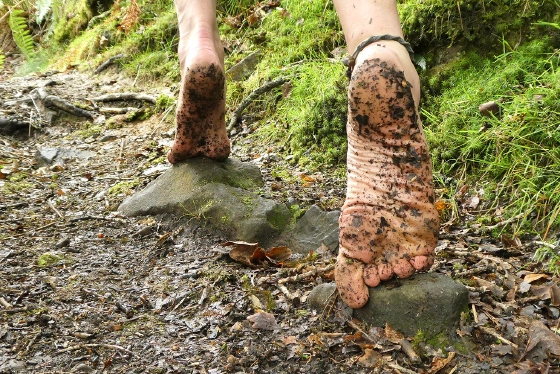
The big thing that happens when you go barefoot on a trail is your gait changes completely. In boots, you heel-strike hard, let the shoe absorb the impact, and keep moving. Barefoot, your body instinctively shifts to a lighter, more midfoot-forward step. You land softer. You bend your knees more. You let your foot spread and grip the ground.
This isn’t just nice in theory. That natural gait is what your whole kinetic chain was built for. Your ankles absorb more efficiently. Your calves do their actual job. Your hips and core engage differently. The connection between your feet and posture becomes obvious the second you step off your boots.
And the skin on your soles? It gets tougher. Not in a nasty callus way, but in a protective, flexible, smart way. Nature’s own shoe sole, custom-built to your exact feet.
The four terrain levels of barefoot hiking
Not all trails are created equal when you’re going barefoot. Here’s how to progress like a smart person and not like someone who just decided to sprint across gravel on day one.
Level 1: Grass & Soft Paths
Level 2: Packed Dirt Trails
Level 3: Beach & Sand Dunes
Level 4: Rocky Terrain
Start at Level 1 and work up. There’s no rush. Even a regular Level 2 hiker has feet ten times more capable than someone who never goes barefoot at all.
How to start safely without wrecking yourself
Don’t just rip off your hiking boots on kilometer 8 of a rocky trail and expect a good time. The barefoot transition needs a bit of strategy, especially when it comes to hiking.
Here’s the actual playbook:
- Start with short barefoot stretches at the beginning or end of an otherwise shod hike even 10 minutes counts
- Find a smooth forest path or a grassy meadow and walk it barefoot at a slow, deliberate pace. Even better if you can find a dedicated barefoot sensory park or trail near you, those are designed exactly for easing into natural barefoot walking
- Pay attention to how your feet feel on the way home mild muscle tiredness is normal, sharp or lingering pain means slow down
- Graduate to longer barefoot sections as your soles toughen and your feet get stronger
- Mix barefoot time with minimalist footwear zero-drop thin-soled trail shoes give you ground feel while protecting from the worst sharp stuff
- Take your first fully barefoot hike on a short, familiar, soft-surfaced trail where you know what’s coming
The key is gradual exposure. Your feet are smarter than you think, they just need time to remember what they’re doing.
The grounding bonus you didn't expect
Here’s the thing nobody talks about when they discuss barefoot hiking: earthing. When your bare skin touches natural ground, soil, grass, rock, actual electron exchange happens between your body and the Earth. That slightly buzzy, deeply calm feeling you get after walking barefoot on natural terrain for a while? That’s not just your imagination.
Research on grounding suggests it can affect cortisol rhythms, inflammation markers, and how well you sleep. Whether you’re fully sold on the science or just know it feels amazing, barefoot hiking delivers this bonus in spades. You’re not just exercising your feet. You’re connecting your whole nervous system to the natural world.
It’s why a barefoot walk in the woods hits different from a treadmill session. Different feels, different brain state, different recovery. Your ancestors knew this instinctively. You get to rediscover it.
What you actually get from barefoot hiking
Let’s make it concrete. Here’s what changes when you start taking your shoes off on the trail:
- Dramatically stronger feet: every step on uneven terrain is a micro-workout for muscles that never fire in regular shoes
- Better ankle stability: natural terrain constantly challenges your ankles in every direction, building real functional stability
- Improved proprioception: your brain gets a richer, more detailed picture of your body position with every barefoot step
- Posture upgrade: when your feet work properly, your whole chain aligns better from toes to neck
- Real earthing benefits: the direct skin-to-earth contact that flat shoes and concrete blocks completely
- Mental reset: something about slow, deliberate barefoot movement in nature just clears the head like nothing else
- Skin that works your soles build exactly the right amount of tough-but-sensitive skin for the terrain you love
Mistakes every beginner makes (and how to skip them)
Going too far too fast
Not watching where you step
Ignoring pain signals
Barefoot Hiking FAQs
Your trail, your feet, no middleman
Barefoot hiking isn’t extreme. It isn’t weird. It isn’t even new. It’s just humans doing what humans have done forever, walking on the earth with their actual feet, feeling every step, building strength and connection with every stride.
You don’t need to do every hike barefoot. You don’t need to go full wilderness monk mode. You just need to try it, even once, on a soft, safe trail for ten minutes. Notice how it feels to actually feel the ground. Notice how your feet wake up. Notice how your brain quiets down.
Then do it again next time. A little longer. A little rougher. A little better.
Your feet are ready. The trail’s been waiting.
Dive deeper into the world of free feet:
- How to transition to barefoot life: the complete step-by-step guide
- Barefoot skin care: keep your trail feet healthy and fresh
- The best surfaces for barefoot walking: know your terrain
- Foot strengthening exercises: prep your feet for the trail
- Earthing and grounding: the science behind barefoot nature contact