Barefoot Kids
You know what kids naturally want to do the second they get home? Rip their shoes off. And you know what most parents do? Tell them to put something on their feet. What if we told you the kids had it right all along?
Those tiny bare feet aren’t being rebellious, they’re being smart.
Kids are literally born barefoot
Think about it for a second. Babies don’t come out of the womb wearing tiny Nikes. Their feet are soft, flexible, mostly cartilage, and that’s totally by design. A kid’s foot is this ridiculously sophisticated sensory organ and movement tool that’s still under construction. It needs input. It needs freedom. It needs the ground.
A baby’s foot has around 200,000 nerve endings, that’s one of the densest concentrations of sensory receptors in the whole body. Read more about just how wild the foot anatomy really is. Those nerve endings aren’t just chilling there for fun. They’re sending crucial info to the brain about texture, temperature, pressure, and terrain. That info literally helps wire up the developing nervous system.
So When We Wrap Those Feet in Rigid Shoes…
We’re basically slapping noise-canceling headphones on one of the body’s most important communication systems. The feet can’t feel anything. The brain doesn’t get its data. And the muscles that should be developing? They never get the signal to grow strong.
It’s like raising a kid in a soundproof room and wondering why they struggle with language. Feet need environmental input to develop properly. Period.
Barefoot time builds better brains
Here’s something that blows most people’s minds: letting kids go barefoot isn’t just about foot health. It’s about brain development. Yep, really.
When a child walks barefoot on different surfaces, grass, sand, pebbles, dirt, wood, every step sends a flood of sensory information to the brain. The brain has to process all of that: “This is bumpy. This is soft. This is warm. This is slippery.” That processing builds and strengthens neural pathways.
The Science Is Real
- Proprioception development: Barefoot walking teaches kids where their body is in space. This is the foundation of coordination, balance, and spatial awareness, skills they’ll use in every sport and physical activity for life
- Sensory integration: The brain learns to mix info from the feet with visual and vestibular (inner ear) data. This integration is key for motor planning and movement control
- Balance and stability: Kids who go barefoot develop better balance than those who always wear shoes. Studies have shown this consistently, barefoot kids outperform shoe-wearing kids in balance tests
- Motor skill development: Barefoot play on uneven terrain forces constant micro-adjustments. Every adjustment is a motor skill lesson. Running on grass, climbing rocks, jumping between surfaces, it’s all building a more capable nervous system
- Confidence and body awareness: When kids trust their feet and feel stable, they move with way more confidence. They take on physical challenges they’d otherwise skip. And that confidence just keeps stacking up over time
Basically, every barefoot step on natural terrain is like a workout for your kid’s brain AND body simultaneously. That’s a two-for-one deal you can’t get from any toy or app.
How barefoot time grows stronger feet
A kid’s foot isn’t just a miniature adult foot. It’s a work in progress. The bones are still mostly cartilage until around age 5-6, and they don’t fully harden into real bone until the late teens. That means the shape of a kid’s foot is literally being shaped by what it goes through during childhood.
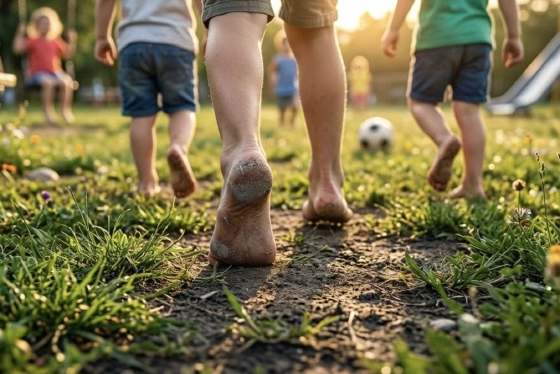
When kids go barefoot, their feet develop naturally. Toes spread wide for stability. Arches develop through muscle activation, not artificial support. The small intrinsic muscles of the foot get strong from gripping, pushing off, and balancing on varied terrain.
But when kids wear rigid, narrow shoes during these critical years, the foot adapts to the SHOE instead of to the GROUND. Toes get squished together. Muscles stay weak. Arches don’t develop properly. You’re essentially putting a growing foot in a mold and hoping for the best.
The takeaway? Less shoe time = better foot development. Full stop.
How rigid shoes damage growing feet
Not trying to scare anyone here, but parents deserve to know what regular kids’ shoes can do to growing feet:
Toe Deformity
Weak Arches
Muscle Atrophy
Poor Proprioception
Gait Problems
Lost Toe Function
The frustrating part? Most kids’ shoes are designed to look cool, not to be good for feet. Cute designs, popular characters, trendy styles, none of that matters if the shoe is messing up the foot inside it. Fashion is temporary. Foot health is forever.
When do kids actually need shoes?
We’re not saying kids should never wear shoes. We’re saying they should wear them less and choose better ones when they do. Here’s the realistic breakdown:
Shoes ON:
- Walking on seriously dangerous surfaces, broken glass, extremely hot pavement, construction areas
- In places that require them, schools, restaurants, stores (sadly, we don’t make the rules)
- Extreme cold where frostbite is a real risk, though cold feet alone aren’t dangerous and brief cold exposure is actually beneficial
- Situations where sharp objects or hazards are hidden, unfamiliar urban areas, industrial zones
Shoes OFF:
- At home, always, if possible. Inside and outside in the yard
- At the park, grass, dirt, sand, playground surfaces are all great barefoot terrain
- At the beach, obviously, but also on the rocks and pebbles, not just the smooth sand
- During play, climbing, running, jumping are all better and safer barefoot (yes, safer, kids grip better with bare feet)
- In nature, forest paths, meadows, streams, anywhere with natural surfaces
The rule of thumb: if the surface is safe and the temperature is reasonable, bare feet win. Every time.
What to look for in kids' shoes
When your kid does need shoes, make them as foot-friendly as possible. The best kids’ shoe is the one that gets closest to being barefoot while still protecting from hazards.
Wide Toe Box
Flexible Sole
Flat (Zero Drop)
Lightweight
What to AVOID:
Arch support (their arches need to develop, not be propped up). Ankle support/high-tops (unless medically prescribed, ankles need to strengthen too). Rigid soles that don’t bend. Fashion-first designs that sacrifice function. Hand-me-down shoes that have molded to another kid’s foot shape.
Barefoot activities kids actually love
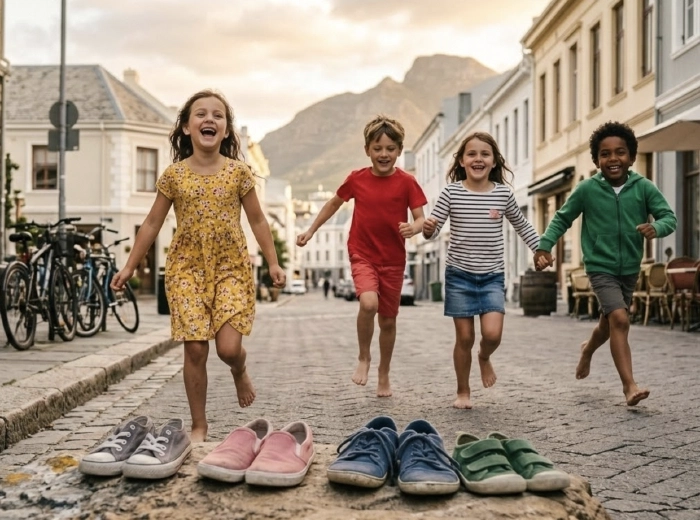
The beautiful thing about kids? They don’t need to be convinced to go barefoot. They want to. You just have to create the opportunities and get out of the way.
- Climbing trees and rocks: Bare feet grip bark and rock surfaces way better than shoes. Kids instinctively know this, watch them kick their shoes off when they want to climb. The gripping action strengthens toe muscles and builds incredible foot dexterity
- Playing in streams and puddles: Water + bare feet = happy kid + sensory development. Navigating slippery rocks in a stream is a proprioception masterclass disguised as fun
- Sand play and digging: Whether it’s a beach or a sandbox, sand provides amazing foot stimulation. Building sand castles with bare feet in the mix, running on dunes, digging with toes, it’s all functional foot exercise
- Balance games: Walking along fallen logs, balancing on low walls, stepping stone paths, kids love these challenges, and they’re phenomenal for foot and ankle development. Set up an obstacle course in the backyard
- Outdoor sports barefoot: Kicking a ball, playing tag, doing cartwheels, all of these are better barefoot. The feet get to grip, push off, and change direction using their full capability. Plus, the sensory feedback makes kids more agile
- Nature scavenger hunts: Get kids walking barefoot on different surfaces while looking for leaves, rocks, feathers, bugs. Tell them they’re exploring the forest like the Magikitos, those fun little barefoot brownies who know every trail and pebble by heart. They’re exercising their feet without even thinking about it. The best kind of workout is the one that doesn’t feel like a workout
But what about...?
We hear the same worries from parents all the time. Let’s tackle them head-on:
"They'll Get Sick!"
"They'll Step on Something!"
"The School Requires Shoes"
"My Kid Has Flat Feet"
Barefoot Kids FAQs
Let those little feet be free
Here’s what it all comes down to: kids’ feet are engineering marvels in progress. They’re built to develop through contact with the ground, through movement, through sensory experience. Every minute a kid spends barefoot on natural terrain is an investment in their physical development, stronger feet, better balance, sharper proprioception, and a more capable brain.
You don’t need to buy special equipment. You don’t need a program or a class. You just need to let your kids do what they already want to do: kick off their shoes and feel the world under their feet.
The grass. The sand. The dirt. The pebbles. The mud between their toes. These aren’t just childhood memories, they’re building blocks for a lifetime of healthy movement.
Your kids’ feet know what they need. Trust them.
Keep exploring the barefoot world:
- Barefoot babies: how it all starts from day one, before they even crawl
- Foot strengthening exercises: once they’re a bit older, these build incredible foot strength
- Toe exercises: wake up those sleeping toe muscles
- Flat feet in kids: what’s normal and what actually needs attention