Barefoot Mindfulness
Most people think mindfulness means sitting cross-legged in a quiet room with eyes closed. Great if that’s your thing. But there’s another way in, one that your ancient nervous system is already built for: walking barefoot and actually paying attention.
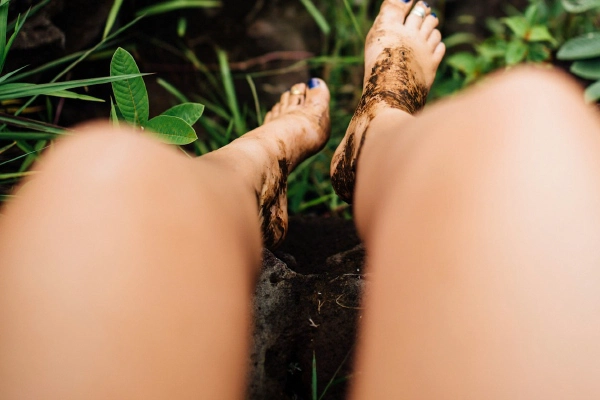
Every bare foot on real ground is an invitation to arrive, fully, in this moment.
What barefoot mindfulness actually is
Here’s the thing: when you walk barefoot on natural ground, your feet are doing something incredible. They’re sending a constant stream of sensory information to your brain. Texture. Temperature. Pressure. Angle. The tiniest shifts in the surface. Your nervous system is processing a flood of data, hundreds of signals per second, all updating in real time.
Your mind can’t be somewhere else. When you’re actually feeling the earth beneath you, you’re here. This moment. This step.
That’s mindfulness. And your feet were built for it.
Barefoot mindfulness is the practice of using that natural sensory connection as a meditation anchor. Instead of following the breath (brilliant, but not for everyone), you follow the feet. Instead of a cushion in a studio, you use real ground. Instead of shutting the world out, you let it in through your soles.
It’s ancient. Every culture that’s ever walked this earth has done some version of this. We just forgot along the way.
Why bare feet are the perfect mindfulness tool
Your shoes are blocking the signal. A thick rubber sole cuts most of the sensory input from the ground. You’re walking, but you’re not really feeling the walking. Your brain doesn’t have much to focus on beyond “left foot, right foot.”
Take the shoes off, and suddenly everything is different.
- Instant sensory richness (the good kind): The moment bare skin touches real ground, hundreds of receptors fire. Your brain has to engage. Wandering thoughts step aside because there’s actual data coming in that needs processing. It’s a natural attention anchor that no app can replicate
- Autopilot breaks down: Autopilot is the enemy of mindfulness. Bare feet kill autopilot. Every step on uneven terrain requires micro-decisions, where to land, how much to shift, where the ground is stable. Your attention stays with the body
- Temperature and texture pull you back: Is this surface warm? Cool? Rough? Smooth? Damp? Each small question brings you back to NOW. Texture and temperature are incredibly effective presence anchors
- You slow down without thinking about it: You physically can’t race through barefoot walking on natural terrain the way you sprint down a sidewalk. Your pace drops. Your awareness expands. The speed of barefoot walking is the speed of presence
The foot anatomy makes this make sense: you have around 200,000 nerve endings on each sole. One of the densest concentrations of sensory receptors in the entire human body. Your feet are a giant living antenna. Give them something real to receive.
How to walk mindfully barefoot
No special place needed. No teacher. No app. You need ground. You need bare feet. Here’s the practice:
Start with stillness. Before the first step, stand barefoot and just feel. What’s under your feet right now? Where’s the pressure? What’s the temperature? Let that question pull you into your body.
Walk at half your normal speed. Maybe slower. Most of us walk to get somewhere. Mindful barefoot walking is going somewhere that isn’t a destination.
Feel each foot fully. Heel contact first. Then the arch coming down. Then the ball. Then the toes spreading and gripping. One foot, fully felt, before the other takes over. The earthing happening in that moment is real, actual ground contact, actual electron exchange.
When your mind wanders, the feet bring you back. A thought about work drifts in? Feel the ground. A worry about tomorrow? Feel the ground. The next step is always an invitation to return.
Notice what shifts. After ten minutes of this, check in with your shoulders. Your jaw. The speed of your thoughts. Something usually moves.

The best surfaces for barefoot mindfulness
Different surfaces bring different qualities of presence. Think of them as different styles of meditation:
Grass
Forest Floor
Sand and Water's Edge
Smooth Pebbles
Bare Earth
Rocky Trails
Explore what different surfaces bring in our guide to walking on different surfaces. The variety itself is a mindfulness practice.
The neuroscience of barefoot presence
This isn’t just vibes. Real stuff is happening in your brain when you walk barefoot mindfully.
- Sensory anchoring quiets the mind: Mindfulness research shows that rich sensory experiences (touch, temperature, texture) are among the most effective tools for quieting the default mode network, the part of your brain that generates rumination and worry. Bare feet flooding your brain with tactile data is sensory anchoring at its most natural
- Proprioception pulls you into the present: Your proprioceptive system, your body’s sense of its own position in space, is deeply linked to the experience of being present. When you’re navigating uneven terrain barefoot, the mental time-travel your mind does when it worries or plans becomes almost impossible. You’re simply too busy being
- The parasympathetic nervous system kicks in: Nature exposure plus physical movement plus mindful attention creates a powerful combination for your “rest and digest” system. Natural terrain walking barefoot is one of the fastest paths to actual nervous system calm
- Stress hormones drop: Studies on nature walks show reduced cortisol and improved attention. Adding barefoot ground contact layers on the grounding effect and makes the shift more pronounced
Three ways to start without overthinking it
Morning Practice
Transition Practice
Evening Reset
If you want to take this deeper into nature, barefoot hiking is the full version. Longer, richer, more intense, the same principles at trail scale.
Barefoot Mindfulness FAQs
The ground has always been there
We spend a lot of time looking for mindfulness in apps, classes, and techniques. And those things work. But right outside your door, in any park or patch of grass, there’s a practice your body already knows how to do. One that your feet were literally built for. One that requires nothing but a willing mind and some bare skin on real ground.
The Brownies figured this out long before anyone invented a meditation app. They just walk. They feel every pebble, every root, every wet patch of moss. Their whole consciousness lives in that contact. No distraction. No rush. Just the ground, the feet, and this moment.
You already have everything you need.
Step outside. Take your shoes off. Walk slow. Feel everything.
Go deeper into the barefoot world:
- Earthing: the science behind barefoot ground contact
- Walking on different surfaces: finding the right terrain for your practice
- Barefoot hiking: mindfulness at trail scale
- What barefoot really means: the symbolism and cultural history of going without shoes
- The barefoot philosophy: why going shoeless is a worldview, not just a habit
- Foot anatomy: why your feet are built for exactly this