Walking on Different Surfaces
When was the last time you walked on something that wasn’t flat, smooth, and predictable? Tile floors, sidewalks, office carpet, gym mats, our feet spend their entire lives on surfaces that require basically zero effort or adaptation. And then we wonder why our balance sucks and our feet hurt.
Your feet evolved for wild terrain. Time to give them what they’re missing.
Modern surfaces are making your feet dumb
This might sound dramatic, but hear us out. The human foot has over 200,000 nerve endings, 33 joints, and 100+ muscles. It’s one of the most complex things in your entire body. And it evolved over millions of years to handle terrain that was anything BUT flat, rocks, roots, slopes, sand, mud, uneven ground in every direction.
Now look at your typical day. You walk on your apartment floor, a smooth sidewalk, a flat office floor, maybe a treadmill, and back to your apartment floor. Every surface is the same: flat, hard, predictable. Zero challenge. Zero variety.
What This Does to Your Feet
- The small stabilizer muscles in your feet never activate, they have nothing to stabilize against
- Your proprioception (awareness of body position) deteriorates because the ground never changes
- Your sole skin stays thin and sensitive because it never faces any texture
- Your brain’s sensory processing for foot data gets lazy, same input, same output, nothing new to learn
- Your balance slowly degrades because your feet haven’t been challenged in years
It’s like eating the same bland meal every day and wondering why your taste buds are dead. Your feet are starving for variety. Every natural surface is a different meal for your nervous system.
Grass
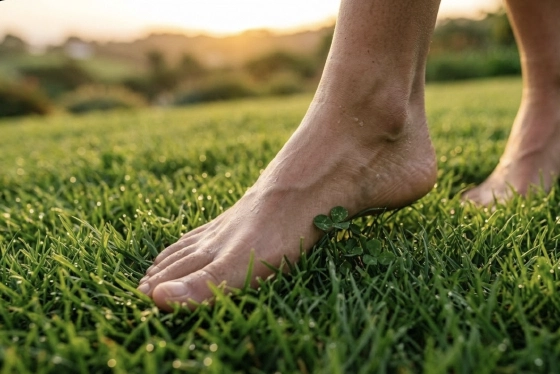
Grass is the gateway drug of barefoot walking. It’s soft, it’s forgiving, and it’s everywhere, parks, backyards, sports fields. If you’ve been in shoes your whole life, grass is where you start.
But don’t mistake “soft” for “easy.” Grass is rarely perfectly flat. There are subtle bumps, dips, roots underneath, and small variations that your feet have to constantly adjust to. Every step is slightly different from the last, which means your stabilizer muscles are working even if you don’t feel it.
The extra perks: Grass is often slightly moist, especially in the morning, which makes it perfect for earthing (electron transfer from the ground). Walking on dewy grass first thing in the morning is one of the best ways to wake up your feet AND your mind. Plus, it just feels incredible, there’s a reason every kid instinctively runs barefoot on grass.
Sand
Sand is a beast. Don’t let the beach vacation vibes fool you, walking on sand is a serious workout for your feet, calves, and glutes. There’s a reason beach runs are used for athletic training.
Soft sand is like walking on an unstable platform. Your foot sinks in, your muscles have to work harder to push off, and your ankles are constantly adjusting for stability. A 20-minute walk on soft sand is more demanding than an hour on pavement. Your intrinsic foot muscles will let you know about it the next day.
Firm wet sand is a different experience, smoother, more supportive, but still with subtle give. It’s like a natural massage for your soles. The grains exfoliate your skin while the firmness provides good ground feedback.
Hot sand (briefly!) gives an intense thermal stimulus that wakes up every nerve ending on your sole. Don’t burn yourself, obviously, but short exposure to warm sand is a powerful sensory experience.
The best part? Sand walking leaves zero impact on your joints while maxing out your muscle engagement. Nature’s gym, no membership required.
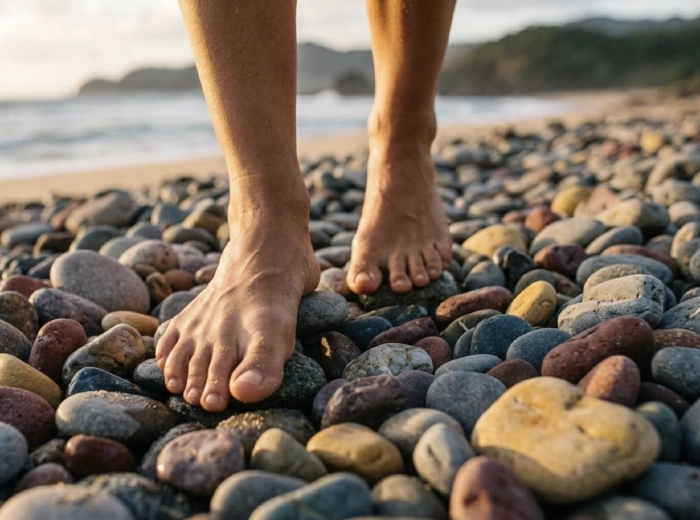
Pebbles and rocks
Alright, this is where things get real. Pebbles and rocks are the surface that most people avoid, and that’s exactly why your feet need them.
Walking on pebbles is intense. Each stone presses into a different part of your sole, stimulating pressure points and nerve endings that flat surfaces never touch. It can be uncomfortable at first (sometimes straight-up painful if your soles are soft), but that discomfort is information, your feet are getting input they’ve been starved of.
The Cobblestone Effect
There’s actually research backing this up. Studies from Oregon Research Institute found that walking on cobblestone-like surfaces seriously improved balance, lowered blood pressure, and boosted physical function in older adults. They called it “cobblestone mat walking”, and the results were impressive enough that it’s now used in some physical therapy programs.
How to Get Started
Don’t just march onto a rocky beach with virgin soles. Start with smooth river stones or pebble paths in parks. Stand still first and let your feet adjust. Then take slow steps. Over weeks, your soles toughen up and what was painful becomes invigorating. Many barefoot enthusiasts say pebble walking becomes genuinely pleasurable once your feet adapt, like a deep tissue massage for your soles.
Forest floor
If we had to pick ONE surface that does the most for your feet, it would be the forest floor. And it’s not even close.
Why? Because a forest floor is EVERYTHING at once. Soft dirt, crunchy leaves, roots, twigs, moss, rocks, pine needles, mud patches, every single step is a completely different stimulus. Your feet never know what’s coming next, which means your brain and muscles are fully engaged the entire time.
Varied Texture
Uneven Terrain
Sensory Richness
The Japanese have a word for this: “shinrin-yoku”, forest bathing. Even the Magikitos, those legendary barefoot forest brownies who’ve been vibing on mossy trails since forever, know that the forest floor is the ultimate playground for your feet. Add bare feet to the mix and you’ve got the ultimate nervous system reset. Your feet get their most diverse workout, your brain gets maximal sensory input, and your stress melts away. If you have access to a forest or even a wooded park, use it. Your feet will thank you.
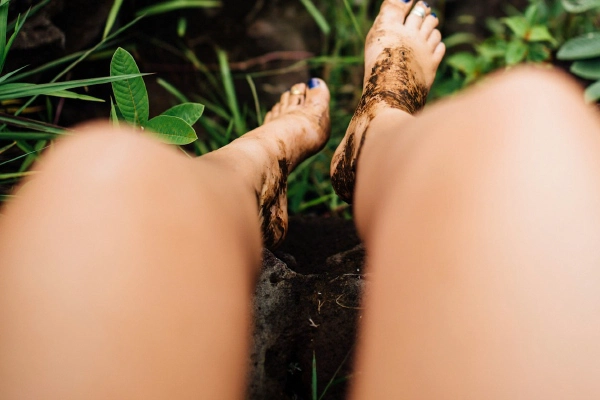
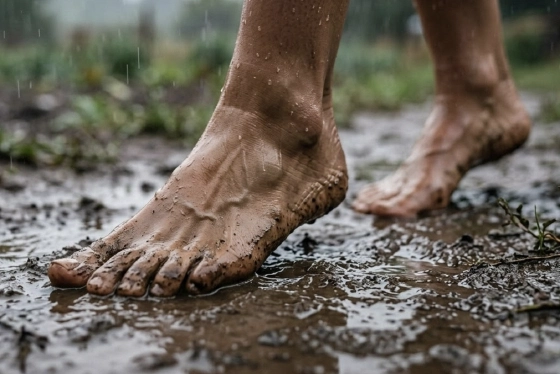
Mud
Mud gets a bad reputation because, well, it’s messy. But from a foot health perspective, mud is phenomenal.
Walking in mud forces your toes to spread wide and grip, it’s one of the best natural toe exercises you can do. The suction effect when you pull your foot out strengthens the whole anterior chain of your foot and lower leg. Your feet are working WAY harder in mud than on any hard surface.
Why Mud Is Secretly Amazing
- Toe activation: Your toes have to spread and grip to maintain traction. This is exactly the movement pattern that modern shoes have trained out of us. Mud brings it back instantly
- Resistance training: The viscosity of mud creates natural resistance for every foot and ankle movement. It’s like strength training for your feet without any equipment
- Temperature stimulus: Mud is usually cool, which provides thermal stimulation to your sole’s nerve endings. Different temperatures activate different receptors, expanding your sensory range
- Skin health: Believe it or not, natural mud can actually be good for skin. It’s been used therapeutically for centuries. As long as you rinse off afterward, your feet benefit from the mineral contact
- Pure fun: Let’s be real, there’s something deeply satisfying about squelching through mud barefoot. It connects you to a childlike joy that most adults have forgotten. It’s impossible to walk through mud without cracking a smile
Obviously, use common sense about WHERE you mud-walk. Natural trails and forest paths after rain? Perfect. Sketchy urban puddles next to a construction site? Hard pass.
What about urban surfaces?
Let’s be honest, most of us don’t live in forests. We live in cities with concrete, asphalt, tile, and more concrete. So what do urban surfaces offer (or not offer) your feet?
Concrete & Asphalt
Tile & Polished Floors
Stairs & Curbs
Parks & Green Spaces
The Urban Foot Health Hack
The city isn’t going to give you varied terrain on your commute. Accept that. But you CAN build surface variety into your routine strategically. Which brings us to the most important section of this article…
How to find natural surfaces in a city
“But I live in a city!” Cool. So do most people. Here’s how to get natural surface time without moving to the countryside:
- City parks: Every city has them. Find ones with unpaved paths, grassy areas, and ideally some rocky or pebbly sections. Make these your barefoot zones. Visit regularly, even 15-20 minutes of barefoot park time a few times a week makes a real difference
- River and canal paths: Many cities have waterside paths with natural ground. River banks often have pebbles, sand, and mud, all prime barefoot terrain. Bonus: the water itself is great to wade in barefoot
- Community gardens: If you have access, gardening barefoot gives you soft soil contact. Even just standing barefoot on garden soil while tending plants is excellent sensory input for your feet
- Beaches (if nearby): You don’t need to live on the coast. Many cities have lakes, reservoirs, or river beaches with sand and pebble shores. Day trips count, a full day of varied barefoot surface exposure is powerful
- Trail networks: Check what’s within a short drive or transit ride. Many cities have surprising trail systems in surrounding hills or forests. A weekly barefoot hike on natural trails is worth more than months of flat-surface walking
- Your own backyard: If you have one, diversify it. Let a patch go to natural ground. Add some smooth pebbles in one area. Keep grass in another. Create your own mini terrain course. Some people even build dedicated barefoot paths in their gardens with different sections
- DIY options: Get a cobblestone mat for your home (you stand on it while brushing teeth, cooking, etc.). Fill a shallow tray with different materials, pebbles, sand, marbles. It’s not the same as nature, but it’s better than nothing for daily stimulation
The point is: natural surfaces exist in cities. You just have to look for them and make them a priority. Most people walk right past patches of bare earth, grassy areas, and pebble paths without ever considering taking their shoes off. Once you start seeing them, they’re everywhere.
Proprioception: the sense you didn't know you were losing
We keep mentioning proprioception, so let’s break it down. Proprioception is your body’s ability to sense where it is in space without looking. Close your eyes and touch your nose, that’s proprioception. Stand on one foot without wobbling, that’s proprioception. Walk down stairs without staring at each step, proprioception.
And here’s the thing: it degrades if you don’t train it. Just like muscles atrophy without use, your proprioceptive sense gets weaker when it’s not challenged. And flat, smooth surfaces in supportive shoes are basically ZERO proprioceptive challenge.
How Different Surfaces Build Proprioception
Soft & Unstable
Hard & Irregular
Mixed & Unpredictable
Why does this matter? Because proprioception is what keeps you from falling. It’s what makes you agile. It’s what athletes lean on for quick direction changes. It’s what prevents ankle sprains (yes, really, people with better proprioception roll their ankles way less often). And it’s what fades with age, leading to falls in older people, falls that can be life-altering.
Building proprioception through varied surface walking isn’t some bonus feature. It’s straight up future-proofing your body.
Walking Surfaces FAQs
Get off the flat stuff
Your feet are the most sophisticated ground-sensing tools in nature. They can detect the tiniest pebble, adjust to the slightest slope, and send a cascade of information to your brain with every single step. But only if you actually give them something interesting to work with.
Flat floors and smooth sidewalks are the foot equivalent of a sensory deprivation tank. They keep you safe and comfortable, sure, but they’re slowly dulling your feet, weakening your balance, and depriving your brain of the rich input it evolved to receive.
The fix is beautifully simple: seek out natural surfaces. Walk on grass. Dig your toes into sand. Navigate pebble paths. Explore forest trails. Let mud squelch between your toes. Each surface is a different chapter in the story your feet were built to read.
You don’t need a gym. You don’t need equipment. You don’t need a program. You just need to find some ground that isn’t flat and boring, take your shoes off, and walk.
The earth beneath your feet is the original gym, the original therapy, and the original playground. All you have to do is show up barefoot.
Explore more of the barefoot world:
- Barefoot on natural ground: the practical guide to grass, earth, sand, and forest floor for intentional barefoot practice
- Earthing and grounding: why your feet love natural surfaces electrically
- Foot reflexology: the original wisdom behind pressure point walking
- Barefoot hiking: the full terrain experience on a trail
- Foot strengthening exercises: complement your surface work